
MHE-R
Material Handling Equipment-Robotics
The Industrial Engineering Term Coined by NIU Scholar
Michael Curtis Broughton
M.Eng.
Core Capabilities
- Non-Palletized Handling: Specialized automated solutions tailored for unique, high-density LRL products like appliances and lumber.
- Dynamic Reconfiguration: Real-time inventory slotting adjustments aligned with seasonal velocity changes.
- 3D Spatial Mapping: Advanced cube utilization tracking using integrated Cartesian grid overlays.
Integrated System
- WES / WCS Orchestration: Direct integration of warehouse control software to direct driverless fleet operations.
- Predictive Analytics: AI and machine learning algorithms driving automated store, stock, and ship execution.
- SCV Linkage: Full supply chain visibility connecting distribution processes directly to financial drivers.
Proven Financial ROI
- Drastic Cost Reductions: Achieves substantial operational savings by optimizing travel paths and eliminating labor constraints.
- EBITDA Margin Improvement: Direct positive impact on P&L through enhanced asset efficiency and reduced equipment wear.
- Reduced Order Errors: Minimizes reshipping costs while accelerating overall time-to-market performance.


Michael Curtis Broughton
Additional NIU Information
Michael Curtis Broughton is an industrial engineer, author, and Northern Illinois University (NIU) alumnus who developed the concepts of Large Retail Logistics (LRL) integration, Material Handling Equipment-Robots (MHE-R), and Dynamic Integrated Bulk Slotting (DIBS). His research at NIU focuses on modernizing distribution operations for non-palletized, heavy, and bulky goods, bridging shop-floor equipment operations with financial drivers and high-level corporate supply chain strategy.
NIU Academic History & Record
Michael Curtis Broughton completed dual graduate degrees through Northern Illinois University’s College of Engineering and Engineering Technology (CEET):
- M.S. in Industrial Management and Technology: Conferred December 13, 2020.
- M.S. in Industrial and Systems Engineering: Conferred May 11, 2024.
- Academic Honors: Maintained a 3.737 cumulative graduate GPA and was inducted into the Alpha Pi Mu Industrial Engineering Honor Society on May 6, 2022.
Research & Thesis: LRL, MHE-R, and DIBS
Broughton’s master's thesis, titled "Large Retail Logistics Warehouse Execution System" (2024), addresses operational bottlenecks in distribution centers (DCs) handling large, non-palletized goods, such as building materials (lumber) and heavy appliances.
Key Concepts & Frameworks
- Material Handling Equipment-Robots (MHE-R): Refers to heavy-duty autonomous mobile robot guided vehicles (AMR/AGVs) designed to replace human-operated heavy machinery, such as forklift machines (FLMs) and clamp-lift machines (CLMs).
- Warehouse Execution & Control System (WES/WCS): Broughton’s model couples a WES/WCS message broker with real-time tracking (such as 3D spatial intelligence heatmaps and overhead RFID/barcodes) to dynamically direct MHE-R actions without human intervention.
- Dynamic Integrated Bulk Slotting (DIBS): An algorithmic approach that automatically reconfigures bulk floor storage based on SKU velocity, seasonal demand shifts, and travel proximity logic.
- Distributor Profitability Linkage: The research links warehouse physical tasks ("Store" functions like put-away, slotting, and picking) directly to accounting lines on P&L statements (COGS, SG&A, EBITDA) to justify the capital expenditures (CAPEX) of robotic automation.

Vehicle Efficiency (VE)
Transforms moving assets into connected flow assets that preserve cargo condition, manage thermal metabolism, communicate readiness, connect safely to infrastructure, and recover predictably. Global Green Logistics (GGL) emerges here.
Regulation Optimization (RO)
Governs the hub by converting plans into safe execution via time-bounded authorization, state-machine logic, multi-sensor verification, independent safety systems, and clear human authority
Network Integration (NI)
Coordinates the wider system, aligning capacity, energy, routing, recovery, digital twin simulations, and commitments across distributed hubs and corridors.
Compliance (C)
Embeds governance directly into physical execution, turning regulatory, customs, and environmental rules into active algorithmic gating constraints—delivering pre-clearance velocity, touchless borders, sensor-verified ESG accounting, and immutable chains of custody.
michaelcurtisbroughton-sole.com


In The News!
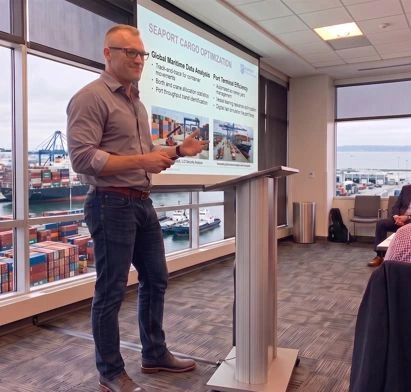
Logistics Expert and Scholar Michael Curtis Broughton Publishes New Book THE SEAPORT EXECUTION SYSTEM.
In The News!
HOUSTON, Aug. 19, 2026 (GLOBE NEWSWIRE) -- Retired U.S. Army Captain, industrial engineer, and logistics innovator Michael Curtis Broughton has published The VERONIC Industrial Standard: An Essential Guide for Fleet and Network Optimization.
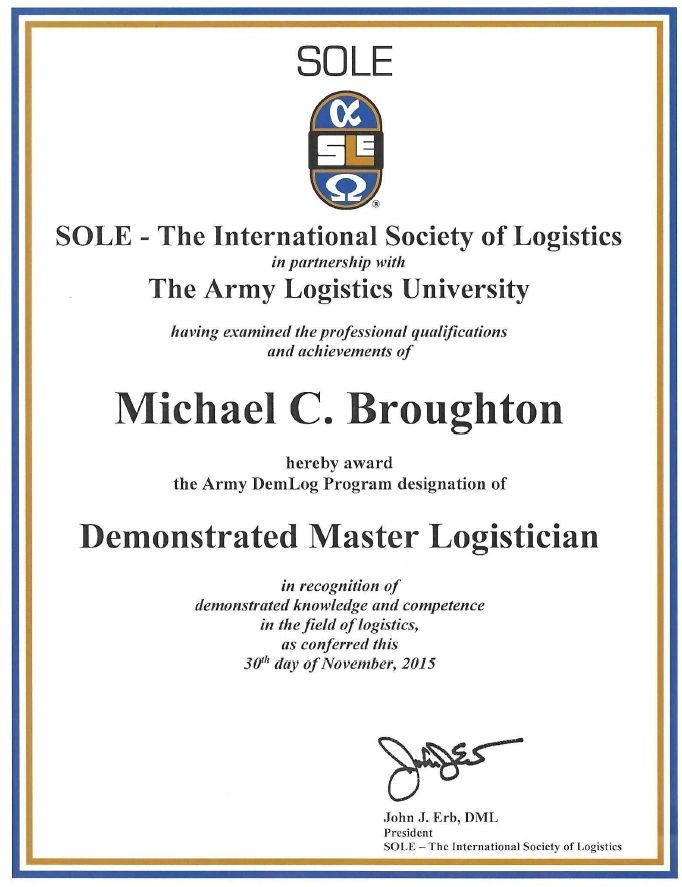
Demonstrated Master Logistician (DML)
SOLE & U.S. Army Logistics University
Executive-level professional designation certifying senior-level expertise in end-to-end supply chain strategy, global distribution, risk management, and enterprise resource planning.
Quality First
Highest Tier Level: The Demonstrated Logistician Program consists of three progressive tiers: Demonstrated Logistician (DL), Demonstrated Senior Logistician (DSL), and Demonstrated Master Logistician (DML). The DML is the highest level of recognition awarded through this program.
Expert Care
Qualifications & Scope: Unlike typical academic certifications that rely on an exam, the DML evaluates a candidate's overall career record. It requires a rigorous mix of extensive professional practice in supply chain and logistics, military/functional education, enabler courses, and formal academic degrees.
Real Results
..Career Impact: For U.S. Army officers, warrant officers, and enlisted personnel, this credential earns promotion points or official code entries on their Officer/Enlisted Record Briefs (ORB/ERB). In the defense and civilian job markets, it serves as professional proof of mastery in end-to-end military and commercial logistics enterprise management.